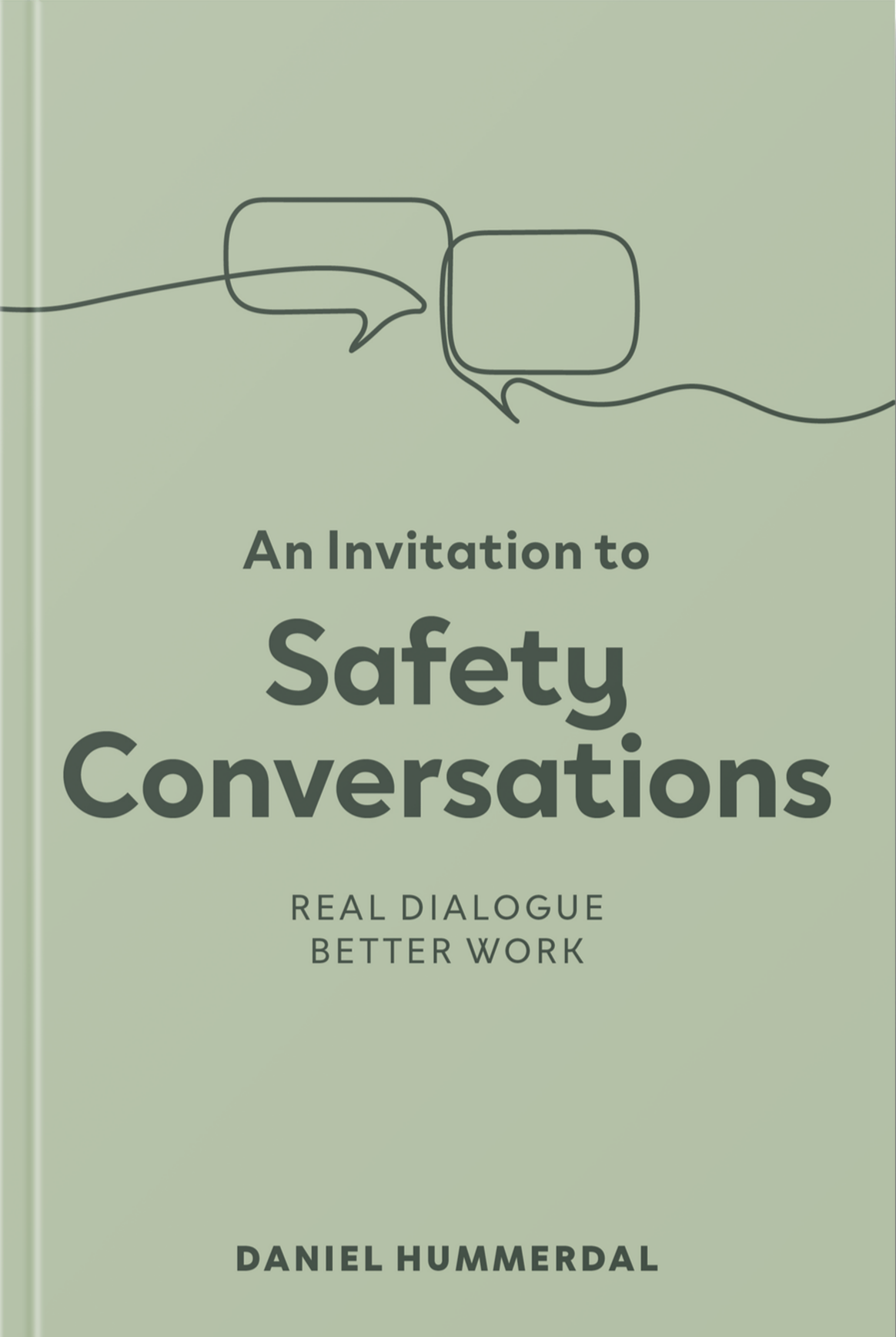

You've invested in safety. But something's still not working.
An Invitation to Safety Conversations shows how dialogue creates organisations where truth can travel, partnership becomes possible, and performance improves, by closing the distance between leadership and the people doing the work.
The distance grows
Leadership checks compliance and order. Workers navigate impossible trade-offs. What each side understands about "how things work" becomes impossible to reconcile.
The signals die
Before things break, they become difficult. Tools don't fit. Schedules force uncomfortable choices. But that everyday strain never reaches anyone who could address it.
The relationship fractures
"Us" versus "them." Managers versus workers. Everyone defaults to protection instead of partnership. Safety becomes something done TO people, not WITH them.
“After years of this, the frustration was palpable. Leaders felt they'd done everything 'right.' Contractors were cynical. Everyone blamed someone else."
Most organisations manage the distance between levels through control: stronger oversight, clearer expectations, and tighter accountability. But control deepens the divide.
Conversation offers a different path.
When dialogue is real, when people can speak honestly about how work happens, what makes it difficult, and what would make it better:
Weak signals reach decision-makers before they become incidents
Frontline intelligence shapes how work is designed
People stop protecting themselves and start contributing
The "us vs. them" fracture begins to heal
This book shows you how to make that shift.
The problem is how your organisation talks to itself
Six conversations types
The book describes six distinct conversation types that leaders and teams move between as they try to understand work, risk, and possibility together.
Each conversation makes different aspects of the system visible.
Connection
Creating the aground where honesty becomes possible
Possibility
Turning adaptations into innovations and constraints into options
Learning
Understanding how work happens
Accountability
Connecting expectations to meaning, identity, and care for others
Appreciation
Recognising what enables success,
Restorative
Repairing trust when it's been strained or broken
What becomes possible
Chapter 1 tells about one struggling infrastructure company: cost overruns, delays, rising injury rates. Leadership kept tightening controls. Workers grew more cynical, and nothing improved.
Then the conversation changed.
Instead of "How do we make them comply?" leaders started by asking "What is getting in the way of good performance?"
Results:
Program delivered in full for the first time
Productivity increased
Incident rate dropped from 60 to zero
Both sides became more profitable
The relationship changed. Not the procedure.
This is what happens when conversation becomes real.
This book is for you if...
✓ You're a safety professional frustrated by the limits of command control-focused approaches
✓ You're a supervisor caught between corporate mandates and frontline reality
✓ You're a manager who knows your people have answers you're not hearing
✓ You're a senior leader tired of getting filtered information
✓ You're an auditor or regulator seeing the gap between what you can inspect and what matters
✓ You're anyone whose conversations shape how work happens
You don't need "safety" in your title for this book to matter.
Wherever people are trying to make work work better under real conditions, conversation is doing more of the heavy lifting than most systems recognise.
From the foreword by Tony Hetherington
Former Head of Energy Division, Health and Safety Executive (GB)
Former Head of High Hazards, WorkSafe New Zealand
"Anyone responsible for safety will recognise the problem. The hardware is in place. The training has been delivered. The procedures are written. And yet accidents still happen, and work doesn’t follow plans. There is a persistent gap between expected and actual performance. This book sets out a thoughtful yet practical way of using conversation to explore why that gap exists. But what matters here is not technique alone, but how those conversations are approached, and the stance taken toward the people involved.”
Available worldwide:
in your local bookstore
via Amazon